Going forward by going back to the Bible
We are not trying to be modern, denominational, or traditional according to men. We are simply striving to be Christians who follow Christ through the teaching of the New Testament.
Because of the possibility of being separated from God (Isa. 59:1-2; 2 Jn. 9), and because sin is serious (Rom. 6:23), we want to take a safe and cautious approach with Scripture.
- We insist on speaking as the Bible speaks (1 Pet. 4:11).
- We insist on being silent where the Bible is silent (Lev. 10:1-2; Deut. 17:3; Heb. 7:14).
- We insist on doing Bible things in Bible ways (Jer. 6:16; 1 Pet. 2:21; Jn. 13:15; Phil. 4:9; Heb. 8:5).
- We insist on calling Bible things by Bible names (Col. 3:17; Acts 4:12).
- We believe we are called by and through the gospel of Christ (2 Thess. 2:14), not by our own “think so’s” (Isa. 55:8-9) or by what “seems right” to man (Prov. 14:12).
- We believe in plain Bible teaching and preaching on all religious and moral matters (2 Tim. 4:2).
- We believe we must have Bible authority for all things done in the name of the Lord (Col. 3:17; 2 Jn. 9).
Simply Christians
By way of introduction, we are a small group of Christians who strive to love God first (Matt. 22:37-38; Matt. 6:33), love one another (Rom. 12:10; Eph. 4:2), build one another up in the most holy faith (Jude 20), and grow in the grace and knowledge of our Lord (2 Pet. 3:18).
We believe that Christ built the church (Matt. 16:18), purchased the church with His own blood (Acts 20:28), gave Himself for the church (Eph. 5:25), and is the foundation of the church (Eph. 2:19-22; 1 Cor. 3:11).
“Neither is there salvation in any other: for there is none other name under heaven given among men, whereby we must be saved.” Acts 4:12
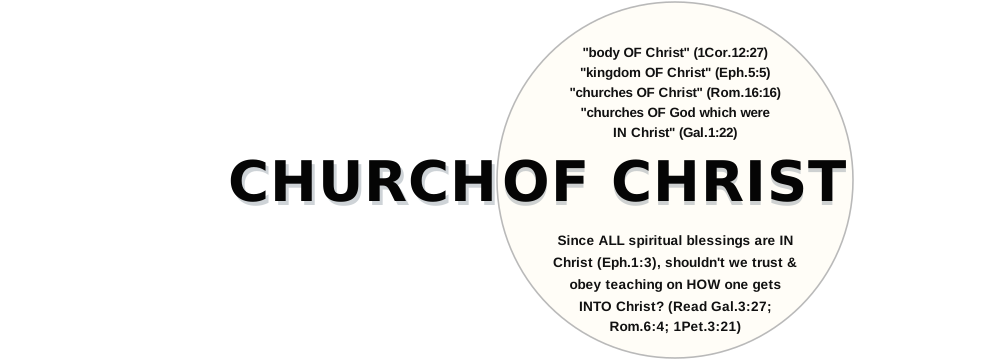
For this reason, we seek to wear the name of Christ, not the names of men. Followers of Christ were called Christians (Acts 11:26; Acts 26:28; 1 Pet. 4:16), and local congregations are identified as churches of Christ (Rom. 16:16), because the church belongs to Christ.
God’s instruction for salvation
We believe salvation is made possible by God, not by human merit. Man cannot save himself. We are saved by God’s grace (Eph. 2:8; Acts 15:11), God’s mercy (Titus 3:5), the blood of Christ (Eph. 1:7; 1 Pet. 1:18-20; Rev. 1:5), and the gospel of Christ (Rom. 1:16; 1 Cor. 15:1-2; Jas. 1:21).
We also believe that the same Bible teaches man must respond to God’s grace through obedient faith. The gospel is to be heard (Rom. 10:13-17), believed (Jn. 8:24; Heb. 11:6), obeyed through repentance (Lk. 13:3; Acts 17:30), confession of Christ (Rom. 10:9-10; Acts 8:37), and baptism into Christ (Mk. 16:16; Acts 2:38; Acts 22:16; Gal. 3:27; Rom. 6:3-4; 1 Pet. 3:21).
We are then to remain faithful to the Lord (Matt. 10:22; 1 Tim. 4:16; Rev. 2:10), continuing in hope (Rom. 8:24) and in works of righteousness that God requires (Acts 10:35; Jas. 2:24; Rev. 20:12; Rev. 22:12).
Worship according to the New Testament
We believe the purpose of the church is to glorify God (Eph. 3:21). Therefore, when we assemble, we seek to worship God “in spirit and in truth” (Jn. 4:23-24), with a sincere heart and according to His revealed will.
- We remember the Lord’s death in the Lord’s Supper upon the first day of the week (Acts 20:7; 1 Cor. 11:23-29; Acts 2:42).
- We pray (1 Tim. 2:1; Acts 2:42; 1 Thess. 5:17).
- We sing and make melody in our hearts to the Lord (Eph. 5:19; Col. 3:16; Matt. 26:30), singing with understanding (1 Cor. 14:15).
- We give attention to reading, teaching, and preaching the Word of God (1 Tim. 4:13; Acts 20:7; 2 Tim. 4:2-4).
- We give as God has prospered us, according as each purposes in the heart (1 Cor. 16:2; 2 Cor. 9:7), so the church may carry out scriptural work.
You will not find us adding mechanical instruments, entertainment, or humanly devised acts of worship. God has instructed His people to sing, teaching and admonishing one another in psalms, hymns, and spiritual songs (Eph. 5:19; Col. 3:16).
The church and the truth of God
The Bible describes the house of God, which is the church of the living God, as “the pillar and ground of the truth” (1 Tim. 3:15). We understand this to mean that the church must uphold, support, and proclaim the truth God has revealed, not replace it with human wisdom, traditions, or organizations (Gal. 1:8-9; Mk. 7:7-9; 2 Jn. 9).
We believe churches must do God’s work in God’s way. The New Testament gives the church the work of preaching the gospel, edifying the saints, and providing scriptural benevolence to needy saints (1 Thess. 1:8; Eph. 4:16; Acts 11:27-30; 1 Cor. 16:1-3; 2 Cor. 8:1-4; 1 Tim. 5:16).
We also recognize a Bible distinction between the work of an individual Christian and the collective work of the local church. Individual Christians may teach, write, encourage, show hospitality, and do good as they have opportunity (Acts 18:24-26; Gal. 6:10; Jas. 1:27), while still respecting the work, organization, and treasury of the local church.
Local church responsibility and autonomy
We believe each local church is responsible to do its own work under Christ, according to the ability God gives. In the New Testament, local churches were made up of saints, and when qualified men were present, bishops or elders served among the flock where they were members (Phil. 1:1; Acts 20:17, 28; 1 Pet. 5:2).
For that reason, we believe local church oversight is local, not regional, national, or denominational. Elders are to oversee the flock “among” them (1 Pet. 5:2), and all things are to be done by the authority of Christ (Col. 3:17).
This conviction is not meant to be harsh or unkind. It comes from a desire to respect the pattern revealed in Scripture and avoid adding arrangements for which we do not find Bible authority.
An invitation to study and worship with us
We do not claim perfection in ourselves. Our confidence is not in human wisdom, personal opinion, or religious tradition. Our confidence is in God, His Word, and the gospel of Christ.
If you are seriously interested in pleasing the Lord, we encourage you to put God first in your life (Matt. 6:33; Matt. 22:37), search the Scriptures (Acts 17:11), obey the gospel from the heart (Rom. 6:17), and assemble with those who desire to worship God in spirit and in truth (Jn. 4:23-24; Heb. 10:24-25).
We cordially invite you to come study the Bible and worship with us. If you have questions, or if you are interested in additional teaching material, please contact us.